
AlgoTest is one of India's most popular options strategy backtesting platforms — but it's not the only option. Whether you're looking for better broker integration, a broader strategy marketplace, or different pricing, there are strong AlgoTest alternatives available for Indian algo traders in 2026.
This guide covers the 9 best AlgoTest alternatives in India, compared by features, list prices, free tiers, broker integrations, and use cases. Before the list, there is a short section on working out why you are leaving AlgoTest at all, because that decides which alternative makes sense. If you're new to algo trading, start with our complete guide to algo trading in India first.
On pricing: the October version of this page described pricing models and printed no rupee figures, because plans were changing every few weeks. Readers kept asking for the numbers, so this update prints them, but only list prices copied from each vendor's own pricing page on 8 November 2026, never a sale price or a figure from a third-party roundup. Offers change faster than list prices, so expect checkout to show something different. Where a vendor's own pages disagree with each other, we say so instead of picking one. Last re-verified: 8 November 2026. This update added the cost table, the free-tier comparison, a section on choosing by reason, a testing checklist, and corrected the Zerodha Streak and broker-count entries.

Why Look for AlgoTest Alternatives?
AlgoTest is excellent for options strategy backtesting — particularly expiry-day strategies like short straddles and iron condors. However, traders look for alternatives when they need:
- A different broker setup. AlgoTest's own pricing blog says it supports 40+ Indian brokers, so broker coverage is rarely the real reason any more. Check your specific broker, not the count
- A strategy marketplace to buy or subscribe to pre-built strategies
- A simpler cost structure. AlgoTest's credit-pack model is cheap per run but hard to budget when you sweep many parameter sets, which some traders find harder than a flat monthly fee
- Multi-asset support beyond just NSE options
- Better live monitoring and alerts dashboards
- Futures and equity strategy support (AlgoTest is primarily options-focused)
First, Work Out Why You Are Leaving
Most "alternatives" lists rank tools as if they all fix the same problem. They don't. People leave AlgoTest for four different reasons, and each one points somewhere different. Name yours before you read the list, because it will cross out half of it.
| Your reason | What to look for | Platforms on this page that fit |
|---|---|---|
| Cost is higher than I expected | A flat plan, or a real free tier, with live deployment priced separately and clearly | Tradetron (free plan, flat tiers), INDfolio (free-forever tier), Zerodha Streak (if you are on Zerodha), AlgoMojo (flat subscription) |
| My strategy cannot be built in the options builder | A general rule engine that handles conditions across instruments, not just option legs | Tradetron, Amibroker, TradingView Pine Script |
| The instrument is not covered | A platform that covers it. This one is a yes or no, so settle it first | Equity and futures: Tradetron, INDfolio (NSE only), Amibroker. MCX or US markets: Tradetron, TradingView |
| Day-to-day friction | Auto-start, readable logs, a kill switch, and whether a static IP is bundled | Check each one in a trial. The testing checklist further down shows how |
Instrument coverage is the fastest filter. If all you do is sell NIFTY or SENSEX options, almost everything below covers you, and the choice comes down to cost and how much adjustment logic you need. If you also trade stocks, MCX or US markets, drop the options-only tools straight away and save yourself a week of trials.
One more thing about switching. We know of no common export format between these platforms, so a move means rebuilding your strategy by hand. For a simple strangle that is an afternoon. For a strategy with re-entries, trailing logic and conditional adjustments it can take days, and the rebuilt version will not behave exactly like the original. Budget for that before you decide that a cheaper plan is worth it.
9 Best AlgoTest Alternatives in India 2026
1. Tradetron — Best for Live Deployment & Strategy Marketplace

Tradetron is the most popular AlgoTest alternative for Indian algo traders who want to move beyond backtesting into live trading. It combines a marketplace of creator-built strategies with its own rule builder, across NSE, BSE and MCX, with US markets and crypto available through supported brokers.
Key features: Tradetron's homepage claims 100+ broker APIs across India and the US (Zerodha and Angel One are among them), a strategy marketplace with subscription options, multi-leg options support, and a per-fill audit log. Two features matter more than the headline list. Live Offline runs your strategy on live prices and records every trade without sending a single order to the exchange, which is a free forward test. The builder also lets strikes, expiries and quantities come from formulas (for example “the strike nearest a target delta”), and lets one leg be repaired after another is stopped, which a plain leg-by-leg builder cannot express.
Pricing model: a free plan, then a ladder of paid tiers that differ by how many live bots you can run and whether you can list on the marketplace. On yearly billing the entry tier is ₹3,000 a year (shown as ₹250 a month) and the top tier is ₹90,000 a year; quarterly billing saves up to 6% and yearly up to 16%. Build and Live Offline are free for life. Current Tradetron pricing.
Best for: Traders who want live deployment across multiple strategies with broker flexibility.
Limitation: the learning curve is real. Tradetron's own comparison with AlgoTest admits it has more to learn and a longer path to a first simple options backtest. Its backtests fill at the open or close of the candle you choose, so you decide the fill assumption, and a strategy driven only by outside webhook signals cannot be backtested at all.
vs AlgoTest: Tradetron has better live deployment infrastructure and broker integrations. AlgoTest has more advanced backtesting specifically for options strategies.
2. Zerodha Streak — Best for Zerodha Users
Zerodha Streak is the most seamless AlgoTest alternative for Zerodha users. Built directly into the Zerodha ecosystem, it offers a no-code strategy builder that can build multi-leg option strategies. It does not place orders for you: a deployed strategy sends an alert and you confirm the order yourself.
Key features (per Streak's help centre, 8 November 2026): a visual strategy builder, advanced mode with 10 entry and 10 exit conditions, up to 100 concurrent deployments, and direct Kite integration. Option-contract backtests are not enabled, there is no paper deployment, and there is no API.
Pricing: this is the entry we corrected most. Older roundups, including an earlier version of this page, list a free trial followed by three monthly tiers. Streak's own site and help centre now say it is free for Zerodha users, and we found no paid tier on it. It needs an active Zerodha account. Streak's own site.
Best for: Zerodha subscribers who want an integrated algo trading experience without switching platforms.
Limitation: Options backtesting is less sophisticated than AlgoTest. Works only with Zerodha.
3. Quantiply — Best for Fully Automated Multi-Strategy Trading
Quantiply is a fully automated algo trading platform that allows you to run multiple strategies simultaneously with live monitoring. It's a strong AlgoTest alternative for traders focused on live execution rather than just backtesting.
Key features: Multi-strategy simultaneous deployment, live position monitoring, instant order updates, broker API integration.
Pricing model: free trial, then paid subscription. Current Quantiply pricing.
Best for: Experienced algo traders who need to run multiple live strategies with reliability.
4. TradingView + Pine Script — Best for Custom Strategy Backtesting

TradingView is the world's most popular charting platform and a strong alternative for custom algo strategy backtesting via Pine Script (their scripting language). While it requires coding knowledge, it offers unmatched charting integration with strategy testing. If you would rather not write Pine yourself, paid indicator packs on TradingView are the other route in.
Key features: Pine Script backtesting, global market support, 100+ pre-built indicators, paper trading, broker connections via webhooks.
Pricing model: free basic tier, then monthly or annual subscription tiers billed in US dollars — so the rupee cost moves with the exchange rate. Current TradingView pricing.
Best for: Traders who want to code custom strategies and test them with the best charting tools available.
5. Amibroker + AFL — Best for Advanced Programmers
Amibroker is the industry-standard desktop trading platform for advanced algo traders who want complete control. Using AFL (Amibroker Formula Language), you can build and backtest virtually any trading strategy.
Key features: Extremely fast backtesting engine, walk-forward analysis, portfolio-level backtesting, custom indicators, NSE/BSE data support via Datafeed plugins.
Pricing model: one-time perpetual licence, sold in US dollars across three editions, with a couple of years of free upgrades included and paid upgrade licences after that. No monthly fee — but budget separately for an Indian NSE/BSE data feed, which Amibroker does not include. Current Amibroker editions and prices.
Best for: Systematic traders and quant researchers who need professional-grade backtesting without subscription fees.
6. Algobulls — Best for Cloud-Based Algo Trading
Algobulls is a cloud-based algo trading platform that supports NSE, BSE, and MCX with a marketplace of strategies. It offers both a strategy builder for non-coders and an API for developer-level customization.
Key features: Cloud execution (no local server needed), strategy marketplace, paper trading, API access, multi-broker support.
Pricing model: free starter plan, then a fairly wide ladder of monthly subscription tiers that scale by deployment limits and instrument coverage — price the tier you actually need, not the entry one. Current AlgoBulls pricing.
Best for: Traders who want cloud-hosted algo execution without maintaining their own servers.
7. INDfolio — Best Free Tier for NSE Options Backtesting
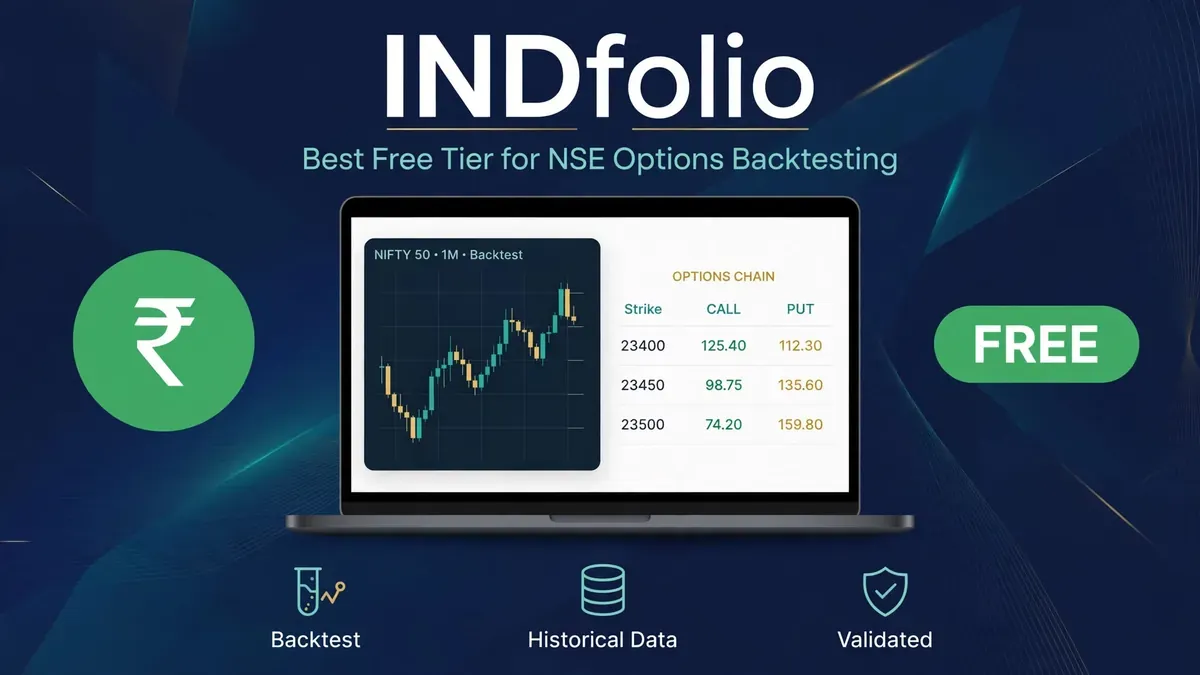
INDfolio is a no-code, AI-assisted platform built specifically for Indian markets, and it is the closest like-for-like alternative on this list for the thing AlgoTest is actually used for: backtesting options strategies on real NSE historical option chains.
Key features: describe a strategy in plain English or build it in a visual editor; backtest across NSE equity, futures, index and options history with real option chains; the full Indian cost stack deducted per leg (brokerage, STT, exchange charges, SEBI fee, GST, stamp duty and slippage); Monte Carlo validation; then paper trade and deploy to a number of supported brokers. The strategy you backtested is the one that deploys.
Pricing model: a genuinely usable free-forever tier (AI strategy generation, visual builder, NSE history, one paper-trading strategy), then Trader at ₹999 a month (live deployment to one broker, optimisation, Monte Carlo) and Pro at ₹2,499 a month (all brokers, unlimited live strategies, walk-forward analysis), GST included, with a 7-day trial on both. INDfolio states there are no per-order, per-strategy or profit-sharing charges. Current INDfolio plans.
Limitations: NSE only — no MCX commodities, no forex, no crypto. The free tier's history window is shorter than the full archive, which matters if you are testing across several volatility regimes rather than validating an idea.
Best for: traders who want to check whether an options strategy idea has any merit before paying for anything, with Indian costs modelled honestly from the start.
vs AlgoTest: comparable intent, different emphasis. AlgoTest still has the deeper, more granular options backtesting engine. INDfolio gets you from idea to a cost-adjusted result faster and for free.
8. Quantman — Best for Minute-Level Options Backtesting With Adjustment Rules
Quantman is the alternative that competes with AlgoTest most directly on its home ground: no-code options strategy backtesting on NSE, with live deployment on the same platform. If you have outgrown AlgoTest's credit packs but still want options-specific testing rather than a generic strategy builder, this is the first one to look at.
Key features: minute-by-minute OHLC backtesting; strike selection by strike price, by strike multiplier, or driven by an indicator; calendar spreads; and — the part most builders actually care about — adjustment logic you can model before you go live, including re-entry and re-execution, move-to-cost, manual adjustments, and trailing stop loss. Live deployment runs on the same strategy definition you backtested, and Quantman states it is integrated with 27 brokers, including Zerodha, Upstox and Angel One. There is also a marketplace of strategies, with some reserved for higher tiers.
Pricing model: a subscription with two plans, Basic and Premium, billed monthly, quarterly or yearly, with a 7-day free trial. List prices on its plans page are ₹1,300 a month plus GST for Basic and ₹3,300 a month plus GST for Premium (quarterly ₹3,700 and ₹9,000, yearly ₹13,000 and ₹29,000). Basic includes 4 live deployments and 250 backtest credits, where one credit is one past financial year of testing, so a single strategy tested over five years costs five credits. Premium raises live deployments to 10 and unlocks manual adjustment. Budget by how far back you intend to test, not by how many strategies you have. Two policy details are stated on Quantman's own site: you cannot downgrade from Premium back to Basic, and there are no refunds. Current Quantman plans and credit quotas.
Best for: options traders who want to test and deploy on one platform, and who need adjustment rules — re-entry, move-to-cost, trailing stops — modelled in the backtest rather than bolted on manually in live trading.
Limitation: the credit model punishes wide exploration. Sweeping many parameter combinations across several years burns backtest credits quickly, so it suits refining a strategy you already believe in more than hunting for one from scratch.
vs AlgoTest: the closest head-to-head on this page. Both are no-code options backtesters that also deploy live, and both meter usage with credits. AlgoTest remains more granular for multi-leg expiry-day testing; Quantman's edge is the breadth of adjustment and strike-selection rules you can express, plus a wider broker list for live deployment. We compare these in more detail in our Tradetron vs AlgoTest vs Quantman breakdown.
9. AlgoMojo — Best for Routing TradingView or Amibroker Signals to Your Broker
AlgoMojo is on this list with an honest caveat: it is not a backtesting replacement for AlgoTest. It solves the other half of the problem. AlgoMojo describes itself as an automated order execution platform that takes buy/sell signals from the tools you already use and places the trades in your broker's terminal. If your strategy logic already lives in TradingView or Amibroker, AlgoMojo is the bridge that makes it trade.
Key features: signal intake from TradingView, ChartInk, Amibroker, NinjaTrader, MetaTrader (MT4/MT5), Excel and Google Sheets; execution across equities, futures and options, including a dynamic options segment; multi-leg strategy support; order execution rules such as long-only, short-only, long+short, stop and reversal; auto rollover; time-based automation; and both paper-trade and live-trade modes. AlgoMojo lists 30+ integrated brokers.
Pricing model: a flat subscription — a 7-day free trial, then monthly, half-yearly or yearly billing, with all plans carrying the same feature set. That flat structure is the specific reason some traders move here from AlgoTest: there are no credits to meter and no per-backtest cost to budget. Current AlgoMojo plans.
Best for: traders who have already validated a strategy elsewhere — in Pine Script, in AFL, or in a spreadsheet — and now need reliable, rule-based execution at their broker without rewriting anything.
Limitation (important): AlgoMojo states plainly that it has no built-in strategies and is purely a signal execution platform. We found no backtesting engine on its site. So it cannot replace AlgoTest on its own — you still need somewhere to test the idea first. Pair it with one of the backtesters above.
vs AlgoTest: not really a competitor so much as a complement. AlgoTest tests; AlgoMojo executes. The common setup is to validate in a backtester and route the resulting signals through AlgoMojo to your broker.
Considered but not added

Four platforms that appear on other "AlgoTest alternatives" lists, or that come up in the same searches, — including AlgoTest's own roundup — were checked and left off this page, with reasons:
- NinjaTrader — a capable platform, but its own site advertises US futures: index, metals, energy, agriculture, single-stock futures and crypto futures. We found no mention of NSE, BSE or Indian options anywhere on it. It is not an alternative for an Indian options trader, whatever a list says.
- Robotrader — a software development company that builds custom trading bots and integrations to order. Genuine work, but it is a bespoke development service with no published pricing, not a self-serve platform you can sign up for and backtest on this afternoon. Different purchase entirely.
- Arthalab — a newer platform for NIFTY and SENSEX index options only. Its own pricing page shows one plan at a list price of ₹1,499 plus GST per 30 days (it currently advertises ₹599 as an offer), with a static IP bundled, 10 backtests a day and a 3-day trial. We have not run it, and everything here is the vendor's own description. It is a fair thing to trial if you sell only index options and the static IP cost is what bothers you, but it covers no stocks, commodities or US markets, so it did not fit a list of general alternatives. Arthalab pricing.
- StockMock — often named next to AlgoTest as an options backtester. Its site blocked our check on 8 November 2026, so we are not describing it.
- Robomatic — we could not reach the platform's own website on 16 October 2026 to verify what it currently offers, so we are not describing it. We would rather leave a gap than repeat another site's feature list as if we had checked it.
Removed from this list
We re-check this page rather than letting it drift, and one entry had to go:
- Zerodha algoZ — removed October 2026. An earlier version of this page listed algoZ as a free AlgoTest alternative. That was wrong: Zerodha retired algoZ back in September 2016 and it has not been available for years. Zerodha's current answer in this space is Streak, which is already at number 2 above. Apologies to anyone who went looking for it on our recommendation.
We keep removal notes like this visible on purpose. A comparison page that only ever grows is a page nobody is checking.
AlgoTest Alternatives — Quick Comparison Table
| Platform | Best For | Pricing Model | Options Backtest | Live Deployment |
|---|---|---|---|---|
| Tradetron | Live deployment, marketplace | Free plan; paid from ₹3,000 a year | Basic | Yes (100+ broker APIs) |
| Zerodha Streak | Zerodha users, beginners | Free for Zerodha users (confirm in Kite) | Not enabled | Alerts only, no auto orders (Zerodha only) |
| Quantiply | Fully automated trading | Free trial, then subscription | Yes | Yes |
| TradingView | Custom strategies, charting | Free tier, then USD subscription | Limited | Via webhooks |
| Amibroker | Advanced programmers | One-time USD licence + data feed | Yes (advanced) | Via API plugins |
| Algobulls | Cloud-hosted execution | Free starter, then monthly tiers | Yes | Yes |
| INDfolio | Free NSE options backtesting | Free-forever tier, then paid | Yes (real NSE chains) | Yes (paid tiers) |
| Quantman | Options backtest + adjustments | 7-day trial, then credit-based tiers | Yes (minute OHLC) | Yes (27 brokers) |
| AlgoMojo | Executing external signals | 7-day trial, then flat subscription | No (execution only) | Yes (30+ brokers) |
What These Platforms Cost to Start (List Prices, 8 November 2026)
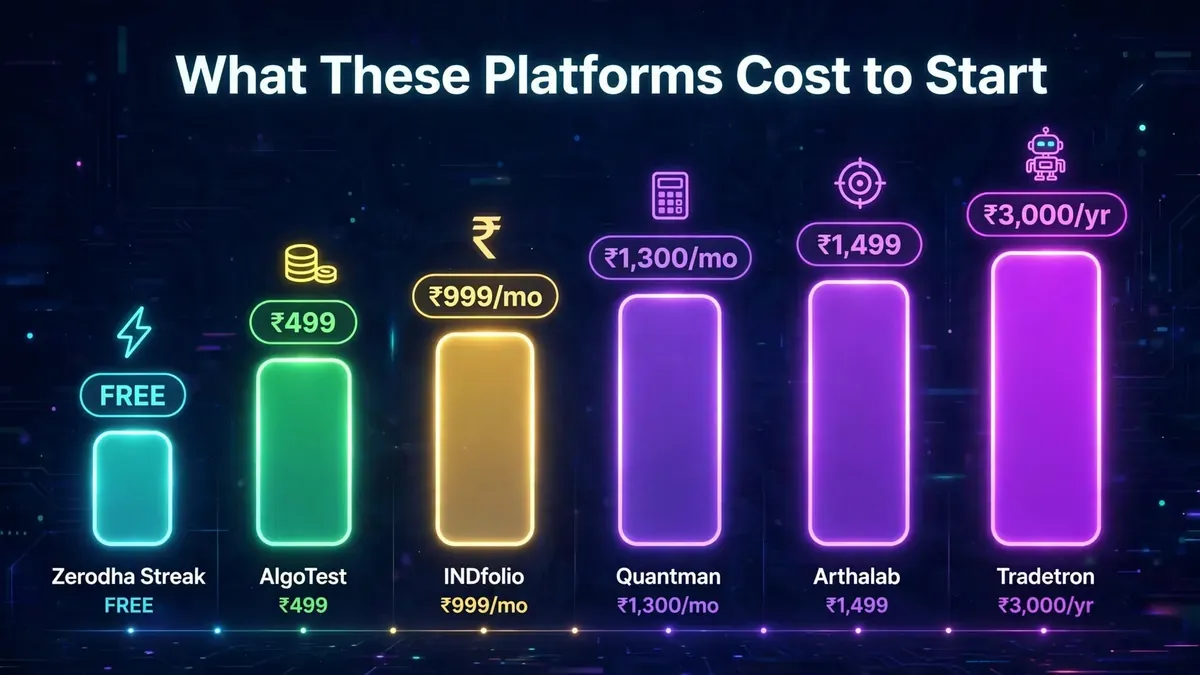
These are list prices from each vendor's own pages on the date above. GST is extra unless stated. Treat the free-way-to-try column as seriously as the price column. A platform you can test properly for nothing saves you more than a platform that is a few hundred rupees cheaper.
| Platform | Free way to try | Entry paid price (list) | Where the real cost sits |
|---|---|---|---|
| AlgoTest | 25 free backtests a week, per AlgoTest | Starter pack ₹499 for 500 credits; Explorer ₹999 for 1,100; Pro ₹2,499 for 3,000. Credits do not expire | 1 backtest = 1 credit. 1 live strategy = 100 credits per 28-day cycle. Paper-trading a strategy = 50. Unlimited-backtest passes exist, but its own pages quote different credit prices for them |
| Tradetron | Free plan. Build and Live Offline (live prices, no orders sent) are free for life | From ₹3,000 a year on the entry tier, up to ₹90,000 a year at the top | How many live bots you need and whether you want to list on the marketplace |
| INDfolio | Free-forever tier, plus a 7-day trial of paid plans | ₹999 a month (Trader) or ₹2,499 a month (Pro), GST included | Live deployment: one broker on Trader, all brokers on Pro |
| Quantman | 7-day free trial | Basic ₹1,300 a month + GST; Premium ₹3,300 a month + GST | Backtest credits (one credit = one past financial year) and live-deployment slots |
| Zerodha Streak | Free for Zerodha users, per its own site | No paid tier found on its current site | You must be on Zerodha, and the strategies cannot move with you |
| Arthalab (not in the nine) | 3-day trial | ₹1,499 + GST per 30 days list; ₹599 offer shown | Index options only. Static IP bundled |

A worked example makes the AlgoTest model easier to judge. Say you run two live strategies for a month and do 100 backtests while refining them. That is 200 credits for the two live slots plus 100 for the backtests, 300 credits in all. At the Starter pack rate of about ₹1 a credit that is roughly ₹300. It is cheaper than most flat plans. The same credit model turns expensive when you sweep: 200 parameter combinations is 200 credits, and a second pass of 200 more is another 200. Flat plans win for people who run many live strategies or test in bulk. Credits win for people who test carefully and deploy a few strategies.
AlgoTest's own pages also disagree with each other in places. Its pricing blog (updated 30 July 2026) lists the Advanced pack at ₹4,999 for 7,500 credits, while its documentation lists ₹5,999 for the same credits and adds an Ultimate pack at ₹14,999 for 20,000 credits. We therefore quote only the packs both pages agree on. Read the live pricing page before you buy: AlgoTest pricing, AlgoTest's plan documentation.
What the sticker price leaves out
- A static IP. If an algo calls your broker's API directly, the broker needs a static IP for it. Some platforms bundle one and most do not. Arthalab, which bundles one, puts buying it separately at ₹500 to ₹1,000 a month, but that is a vendor's figure, so ask your own broker or host. Our SEBI algo trading rules explainer covers when the requirement applies, and our broker API guide covers the setup.
- Brokerage on every order. A strategy that places 10 orders a day at a flat ₹20 an order costs ₹200 a day in brokerage before the platform charges you anything. Multi-leg strategies place more orders than people expect, because every leg and every stop is its own order.
- A data feed, if you use Amibroker. Amibroker does not include an Indian NSE/BSE feed, so budget it separately.
- Slippage. Not a fee, but the biggest gap between a backtest and your account. Check what each platform assumes. Tradetron, for one, fills at the open or close of the candle you pick, which is your assumption to make and not the market's.
Free Ways to Try Before You Pay
You do not have to pay anyone to find out whether a platform fits. Three free routes are worth using, in this order.
- Free backtests. AlgoTest says 25 a week. INDfolio's free tier includes NSE backtesting with the Indian cost stack deducted. Use these to check whether your idea survives costs at all.
- A free simulator. AlgoTest has a free option simulator and Tradetron has a strategy simulator that replays a past day on its real option chain. A simulator shows you how a structure behaves through a day. A backtest tells you what it did over many days. They answer different questions, and we explain the difference in option simulator vs backtest.
- A free forward test. Tradetron's Live Offline mode runs the strategy on live prices and records every trade without sending orders. Run it for a couple of weeks and compare the fills with your backtest. AlgoTest charges 50 credits per strategy per 28-day cycle for forward testing, which is cheap but not free. Streak, being free for Zerodha users, sends alerts when a rule's conditions match, but it has no paper deployment.
How to Test a Platform Before You Trust It With Money
A feature list tells you what a platform says it can do. These checks tell you what it does. They work on any tool in this guide.
- Rebuild one strategy you already know. Pick one whose real results you trust, build it on the new platform and compare. Costs, fills and drawdown should roughly agree. If they do not, find out why before you move capital. A platform that cannot reproduce a result you already understand will not help you with one you do not.
- Check the fill assumption. Ask what price a backtested order gets and whether slippage and brokerage are deducted per leg. Two platforms can run the same rules and report different profits purely because of this.
- Paper trade for at least two weeks. Not two days. You want to see a few expiries, a gap and a stop that gets hit. Our paper trading guide says what to look for.
- Cause a rejection on purpose. Send an order that should fail, such as an invalid quantity, and read what the platform logs. A platform that keeps the broker's raw error is far easier to run than one that says "order failed".
- Find the kill switch before you need it. One control that stops all new orders. Test it in paper mode.
- Do not run the same strategy live on two platforms against one broker account. Test them side by side in paper mode instead.
What no platform changes: the daily broker login on self-serve brokers, the static IP rule, exchange margin requirements, and the gap between backtest and live results. If a pitch implies any of those goes away, walk off. For a plain account of that last gap, read what a backtest can and can't prove and how to backtest an option-selling strategy. Test data matters too: see NSE historical options data for what a backtest is actually built on.
Staying on Zerodha: What Changes if You Leave AlgoTest
"AlgoTest Zerodha" is one of the most searched phrases around this tool, and most of what comes back is setup tutorials for linking the two. Our own breakdown, what AlgoTest with Zerodha does and does not do for multi-leg option selling, covers the part those tutorials skip. If you stay on Zerodha and leave AlgoTest, your realistic options are Streak (free, Zerodha only), or Tradetron, Quantman and INDfolio, all of which list Zerodha among their supported brokers. Whichever you choose, rebuild and paper trade before you switch live, and read Tradetron vs AlgoTest vs Quantman for a closer head-to-head on the three most common switches. For a different style of automation again, see Stoxxo vs Tradetron.
Which AlgoTest Alternative Should You Choose?

Here is the decision framework for Indian algo traders:
- If you need live deployment across multiple brokers: Choose Tradetron
- If you are a Zerodha user and want seamless integration at no cost: Choose Zerodha Streak (free for Zerodha users, per its own site)
- If you want to run multiple automated strategies simultaneously: Choose Quantiply
- If you need options backtesting with adjustment rules, then live deployment on the same platform: Choose Quantman
- If your strategy already works in TradingView or Amibroker and you only need execution: Choose AlgoMojo — but keep a backtester alongside it, since AlgoMojo does not test strategies
- If you are a developer and want maximum flexibility: Choose TradingView (Pine Script) or Amibroker
- If you want a free starting point for options backtesting specifically: Choose INDfolio (free-forever tier, real NSE option chains) or Algobulls (free starter)
- If you want to test with live prices before paying anything: Use Tradetron's free Live Offline mode, then compare the fills with your backtest
- If you still need advanced options backtesting: Keep AlgoTest — it remains the strongest for NSE options strategy testing
For context on how these strategies work in practice, see our guides on algo trading strategies for Indian markets, free algo trading software in India and options backtesting software in India. If you would rather not manage a platform at all, EliteAlgo runs rule-based and quant-based index option-selling strategies on NIFTY and SENSEX for clients — see our services and how the strategies work. Whichever route you take, paper trade first.
If you arrived here from a search for "Algobi alternatives", read what Algobi actually is and what Indian option sellers can use instead first.
Frequently Asked Questions — AlgoTest Alternatives India
What are the best AlgoTest alternatives in India?
The best AlgoTest alternatives in India are Tradetron (live deployment + marketplace), Zerodha Streak (best for Zerodha users), INDfolio (free tier with real NSE option chains), Quantiply (fully automated multi-strategy), Quantman (minute-level options backtesting with adjustment rules), AlgoMojo (routes TradingView/Amibroker signals to your broker), TradingView (custom Pine Script strategies), and Amibroker (advanced programmers). Each excels in different areas — Tradetron for live trading, Quantman for options backtesting plus deployment on one platform, Amibroker for advanced backtesting, TradingView for charting-integrated strategies.
Is AlgoTest free to use in India?
Partly. Every AlgoTest user gets a set number of free backtests each week — enough to try the platform and test a basic options strategy. Past that, AlgoTest is no longer a flat monthly plan: it moved to a credit-pack model during 2026. You buy a pack of non-expiring credits, and backtests, forward tests and live strategies each consume credits. Pack sizes and credit costs have been revised, so confirm the current numbers on AlgoTest's own pricing page rather than trusting any comparison list, including ours.
Which is better — Tradetron vs AlgoTest?
Tradetron and AlgoTest serve different needs. AlgoTest is better for options backtesting — especially NSE expiry-day strategies. Tradetron is better for live deployment, with 100+ broker APIs by its own count and a strategy marketplace. Many professional algo traders use both: AlgoTest for testing, Tradetron for going live.
Can I backtest options strategies in AlgoTest alternatives?
Yes — INDfolio, Quantman, Tradetron, Quantiply, Algobulls and Amibroker all support options strategy backtesting in India. INDfolio is the closest like-for-like swap: real NSE option chains, with brokerage, STT, exchange charges, GST, stamp duty and slippage deducted per leg. Quantman is the closest on mechanics — minute-by-minute OHLC backtests with re-entry, move-to-cost and trailing stop-loss rules you can model before going live. AlgoMojo is the odd one out: it executes signals but has no backtesting engine at all. For the most granular multi-leg expiry-day testing, AlgoTest is still the most specialised tool.
How much does AlgoTest cost in India?
AlgoTest runs on credits, not a flat monthly fee. Its documented packs include Starter at ₹499 for 500 credits, Explorer at ₹999 for 1,100 and Pro at ₹2,499 for 3,000, and credits do not expire. A backtest costs 1 credit, a live strategy costs 100 credits per 28-day cycle, and paper-trading a strategy costs 50. AlgoTest also says every user gets 25 free backtests a week. Its own pages disagree on the larger packs, so check the live pricing page before buying.
Is Zerodha Streak free now?
For Zerodha users, it appears so. Streak's help centre says it is free for Zerodha users, and we found no paid tier on it, although older roundups still list some. It only works with a Zerodha account, and it sends alerts rather than placing orders.
Which AlgoTest alternative is cheapest to go live with?
It depends on how many strategies you run. Tradetron has a free plan and its entry paid tier is ₹3,000 a year on yearly billing. INDfolio is free to build and backtest, with live deployment from ₹999 a month. Streak is free for Zerodha users. Quantman starts at ₹1,300 a month plus GST. Remember that a static IP and per-order brokerage are extra on almost all of them. The cost table above has the detail.
Do I need a static IP to run an algo on these platforms?
If your algo places orders through your broker's API on your own behalf, the broker needs a static IP registered for it. Some platforms bundle one and many do not, which is a hidden monthly cost. Our SEBI algo trading explainer covers when the rule applies. Confirm with your broker and platform before you subscribe.
Can I move my AlgoTest strategy to another platform?
Not directly. We know of no common export format between these platforms, so you rebuild the strategy by hand. A simple strangle takes an afternoon. A strategy with re-entries, trailing stops and conditional adjustments can take days, and the rebuilt version may not behave exactly like the original, so paper trade it first.